The dinner table just got a little quieter, or perhaps a lot louder. Your daughter is growing up, navigating friendships, school, and soon, the complex world of romantic relationships. As she steps into her own, one fundamental lesson underpins every interaction she'll have, every choice she'll make, and every person she'll become: Teaching Respect: For Yourself, Your Daughter, and Her Partners. This isn't just about good manners; it's about building an unshakeable foundation for a fulfilling life, rooted in self-worth, empathy, and healthy connections.
It's a journey, not a destination, for you and her. But with intention and practical tools, you can equip her—and yourself—with the understanding that respect is the currency of a well-lived life.
At a Glance: Key Takeaways for Cultivating Respect
- Model Respect First: Your actions are her most powerful lesson.
- Self-Respect is Foundational: Teach her to value herself above all else.
- Boundaries are Non-Negotiable: Empower her to say "no" and to respect others' "no."
- Empathy is a Superpower: Guide her to see and value diverse perspectives.
- Relationships Thrive on Mutual Respect: Prepare her for healthy friendships and romantic partnerships.
- Effort Outweighs Outcome: Praise her hard work, not just her successes.
- Talk About It: Make respect a regular, open conversation in your home.
Why Respect Isn't Just "Nice," It's Necessary
Respect, at its core, is about "Treating others the way you want to be treated." It’s the bedrock of society, the lubricant for personal interactions, and the quiet strength that builds confidence. But its impact goes far deeper than just civility. Teaching respect early and consistently fosters:
- Positive, Enduring Relationships: When we act with respect, we open channels for effective communication, cooperation, and genuine collaboration. This means stronger friendships, better family dynamics, and eventually, healthier romantic partnerships.
- Deepened Empathy and Understanding: Respect requires us to consider others' feelings, perspectives, and boundaries. This cultivation of empathy broadens horizons, fosters tolerance for diversity, and helps your daughter navigate a complex world with grace.
- Unshakeable Self-Respect: The act of respecting others inherently guides us to value ourselves. It reduces harsh self-judgment, replacing it with a recognition of our own worth and abilities. This builds self-esteem, self-confidence, and a positive self-image that can withstand life's inevitable bumps.
- A Shield Against Conflict and Bullying: Disrespect is often the root of aggression and conflict. By embedding respect as a core value, you're giving your daughter a powerful deterrent against disrespectful behavior, both as a potential victim and, crucially, as a perpetrator. It creates safer, kinder environments, starting with her own life.
This isn't just theory; it's a practical necessity for her success and happiness, and for fostering a harmonious society around her.
Chapter 1: The Unseen Foundation – Cultivating Your Daughter's Self-Respect
Before she can truly respect others or demand respect from partners, your daughter must first respect herself. This isn't about arrogance; it's about an inner knowing of her worth, a quiet confidence built through consistent, small choices.
The Unspoken Lesson: Modeling Self-Respect
Children are sponges. They observe how adults—especially their parents—treat themselves. This means your self-respect is her blueprint.
Are you constantly critical of your appearance, your choices, or your abilities? Do you overcommit, always put others first, or rarely take time for yourself? She’s watching.
A University of Michigan study highlighted that daughters whose mothers modeled self-compassion developed healthier self-esteem and body image. It’s not about being perfect; it’s about acknowledging your humanity. When you accept a compliment with a simple "Thank you," rather than deflecting it, you teach her to value praise. When you choose a simple, nourishing meal after a hard day because you deserve to rest, you model self-worth, even in tough moments.
Your Action: Show her what self-care looks like, how to speak kindly to yourself, and that your needs matter. Take that walk, say "no" to that extra committee, or simply enjoy a quiet moment. Your example speaks volumes.
The Power of "No": Helping Her Set and Hold Boundaries
Self-respect requires clear, firm boundaries. This is where your daughter learns the vital difference between kindness and being a doormat. It’s about understanding that her time, energy, and emotional space are valuable.
Encourage her to practice saying "no" in low-stakes situations—like declining a playdate when she’s tired, or saying "no, thank you" to an unwanted snack. Research from Girls Leadership shows that teaching boundary-setting equips girls to handle peer pressure and unhealthy relationships later on. Role-playing different scenarios, like playground conflicts or group pressure to do something she's uncomfortable with, can build her confidence.
And when she does say "no," support her. Validate her choices, even if they slightly inconvenience you. This reinforces that her voice and her boundaries matter.
Your Action: Help her identify what her boundaries are and practice asserting them. When she pushes back respectfully, affirm her right to do so.
Beyond the Win: Celebrating Effort Over Outcome
In a results-driven world, it's easy for children to link their self-worth to their achievements. But focusing solely on outcomes can breed perfectionism and a fear of failure.
Carol Dweck's research on growth mindset reveals that children praised for their effort (e.g., studying hard, practicing diligently, helping others even when it's tough) are more resilient and self-assured. They understand that mistakes are part of learning, not a reflection of their inherent worth. Celebrate the process, the struggle, and the learning, not just the A+ or the winning goal.
Your Action: When she brings home a graded paper or talks about a challenge, ask about her effort. "You really studied hard for that, didn't you?" or "It took a lot of courage to try that." This shifts her internal dialogue from "Am I good enough?" to "Am I trying my best?"
Body Talk: Focus on Function, Not Flaws
The way we talk about bodies—our own and others'—profoundly shapes a daughter's self-perception. Avoid labeling foods as "good" or "bad" or constantly criticizing your own appearance. Such language can sow seeds of shame or disordered eating.
Dr. Linda Papadopoulos suggests discussing bodies in terms of what they do—run, hug, build, create, eat, rest—rather than how they look. Emphasize health and capability. Gently remind her that bodies come in all shapes and sizes, and hers is perfectly suited for her. This empowers her to appreciate her body's strength and unique qualities, rather than comparing it to external ideals.
Your Action: Keep body conversations practical and functional. Praise her strength, her energy, her ability to move and play. Challenge negative body talk, both from yourself and others.
Surrounding Her with Strength: Positive Role Models
Self-respect isn't built in a vacuum. Expose your daughter to a diverse array of confident, kind, and capable women and girls. These might be teachers, coaches, authors, community leaders, older cousins, or even characters in books and movies.
Encourage friendships with girls who lift each other up, who value themselves, and who demonstrate respectful interactions. When reading stories or watching films with strong female characters, discuss their strengths, their challenges, and how they navigated complex situations. Point out that self-respect isn't about perfection; it’s about owning choices, learning from mistakes, and standing firm in one's values.
Your Action: Curate her environment. Seek out inspiring stories, facilitate positive friendships, and discuss the qualities you admire in various women.
Chapter 2: Extending the Circle – Guiding Your Daughter to Treat Others with Respect
Once self-respect takes root, the capacity to extend respect to others flourishes. This isn't just about being polite; it's about acknowledging the inherent worth and dignity of every individual.
Leading by Example, Always
This fundamental principle bears repeating. Your interactions with your spouse, friends, neighbors, service providers, and even strangers are her most consistent lesson. Do you listen actively, even when you disagree? Do you offer appreciation? Do you handle conflict with grace and empathy?
Show her what it looks like to hold a different opinion respectfully, to apologize sincerely, and to offer help without judgment. When you model respectful conduct, you demonstrate that it's a non-negotiable part of your family's values.
Your Action: Be mindful of your own behavior. If you slip up (we all do), acknowledge it. "Mommy wasn't listening very well just now, and that wasn't respectful. I'm sorry. What were you saying?"
The Blueprint: Setting Clear Expectations
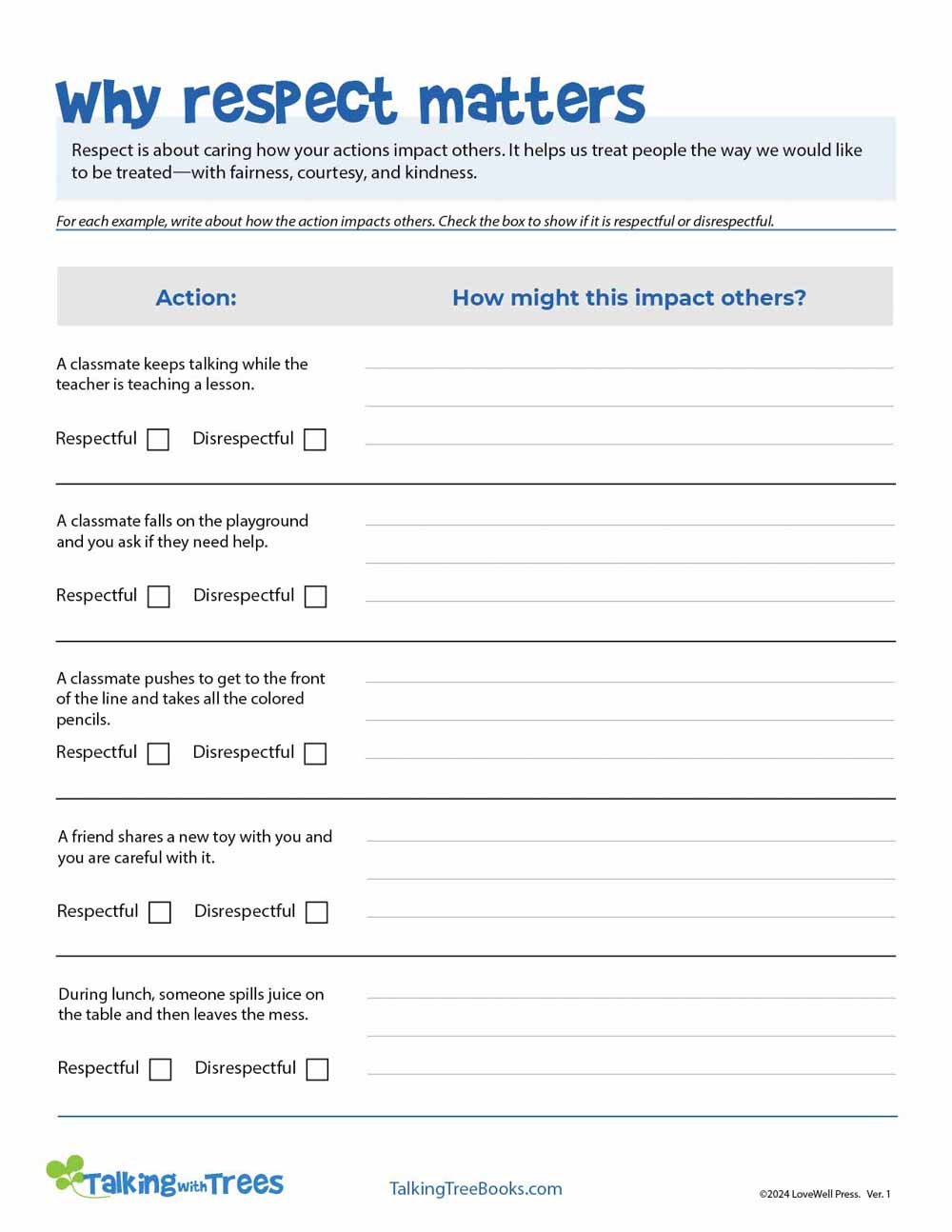
Respect isn't a nebulous concept; it has concrete manifestations. Define what respectful behavior looks like in various contexts within your home and beyond.
- Active Listening: Emphasize making eye contact, not interrupting, and truly hearing what someone says.
- Polite Language: The power of "please," "thank you," and "excuse me."
- Acknowledging Feelings: Validating others' emotions, even if you don't agree with their reaction.
- Respecting Property: Asking before borrowing, returning items, and taking care of shared spaces.
These clear expectations provide a framework for her to understand and practice respectful interactions.
Your Action: Have family discussions about specific scenarios. "What does it look like to respect grandma's quiet time?" or "How do we show respect to our teacher?"
Opening the Dialogue: Talking About Respect
Don't assume she understands. Initiate open conversations about respect through discussions, storytelling, and reflective activities. Use real-life situations as teachable moments.
- Story Time: Discuss how characters in books show or fail to show respect.
- Current Events: Talk about how respect (or lack thereof) plays out in news stories.
- Personal Reflections: Ask her, "How did it feel when that person was rude to you? How do you think they felt when you shared your toy?"
These dialogues help her internalize the concept and connect it to emotional outcomes.
Your Action: Regularly bring up the topic. Make it a natural part of your family's conversations, not a lecture.
Learning by Doing: Group Activities and Role-Playing
Practice makes perfect. Engaging children in activities that require cooperation and empathy helps them understand respect on a practical level. The "Assembly Line Clean-up" mentioned in research—where teams work together to collect trash—is a fantastic example. Afterward, discussing how respect (cooperation, listening, teamwork) contributed to the task's completion solidifies the lesson.
Role-playing is another powerful tool. Simulate different scenarios: how to share a toy, how to respond to a friend's sadness, or how to politely decline an invitation. This allows her to practice respectful communication and problem-solving in a safe environment.
Your Action: Look for opportunities for her to collaborate with others. Use imaginative play or brief scenarios to practice respectful interactions.
Embracing the World: Celebrating Diversity
Respect for others means acknowledging and honoring a variety of cultures, backgrounds, and experiences. Expose your daughter to different traditions, foods, languages, and perspectives.
This isn't just about tolerance; it's about appreciation. When she sees the beauty and value in differences, she learns that respect transcends superficial categories and fosters a truly inclusive attitude. Celebrate holidays from other cultures, read books by diverse authors, and encourage friendships with children from various backgrounds.
Your Action: Intentionally broaden her world. Seek out diverse experiences and discuss how unique perspectives enrich life.
Catch Her Being Good: Positive Reinforcement
When you see your daughter demonstrating respectful behavior, acknowledge and praise it. Be specific. Instead of just "Good job," say, "I noticed how you listened patiently to your friend even when you disagreed. That showed great respect for her feelings." Or, "Thank you for asking before taking a cookie. That's very respectful of our family rules."
Specific feedback highlights the positive impact of her actions and motivates her to repeat them. It shows her that her efforts to be respectful are seen and valued.
Your Action: Be a keen observer. Catch her in the act of being respectful and offer genuine, specific praise.
Chapter 3: Navigating Relationships – Respect for Her Partners (and What to Expect)
As your daughter grows, her relationships will deepen and expand into the realm of romantic partnerships. This is arguably where the lessons of self-respect and respect for others will be tested most profoundly. Your role is to equip her not just for good relationships, but for healthy ones built on mutual respect.
From Friendship to Romance: Applying Respectful Principles
The core principles of respect don't change just because "love" enters the picture. In fact, they become even more crucial. A truly respectful romantic relationship is characterized by:
- Clear Communication: Open, honest dialogue about feelings, needs, and desires.
- Consent: Explicit, enthusiastic agreement in all physical and emotional interactions. This is non-negotiable.
- Mutual Boundaries: Respect for each other's personal space, time, and autonomy. Understanding that a partner doesn't "own" them.
- Emotional Support: Being present, empathetic, and uplifting without being codependent or controlling.
- Valuing Individuality: Encouraging each other's growth, separate interests, and friendships.
- Conflict Resolution: Addressing disagreements fairly, without aggression, name-calling, or stonewalling.
These are the pillars of a partnership where both individuals feel seen, heard, and cherished.
Your Action: As she starts dating, discuss these principles. "What does it feel like to be truly listened to?" "How do you know if someone respects your wishes?"
When It's Not Right: Recognizing Disrespectful Behavior
Equally important is teaching her to recognize red flags of disrespect. Not all disrespect is overt aggression; sometimes it's subtle manipulation, gaslighting, or emotional control. Empowering her to identify these behaviors early can protect her from harmful situations.
Teach her to watch for:
- Lack of Empathy: A partner who dismisses her feelings or struggles.
- Controlling Behavior: Dictating who she sees, what she wears, or how she spends her time.
- Constant Criticism: Putting her down, even "jokingly."
- Isolation: Trying to separate her from friends or family.
- Disregard for Boundaries: Pushing past "no" or ignoring her comfort levels.
- Gaslighting: Making her doubt her own perceptions or sanity.
Her gut feeling is a powerful indicator. Teach her to trust it.
Your Action: Have candid conversations about healthy vs. unhealthy relationships. Use examples from media or stories (anonymously) to illustrate red flags.
Your Role: Teaching Boundaries in Dating and Beyond
As her parent, you're not just observing; you're actively preparing her. Your discussions about dating should be grounded in respect—for herself, for her partner, and for the kind of relationship she deserves. This is where a framework, even an informal one, can be helpful. Think about the conversations you want to have with her.
For many parents, creating clear guidelines can be a good starting point for these sensitive conversations. You might even find some value in thinking about Rules for dating my daughter as a way to open a dialogue about your expectations for her safety and well-being. This isn't about control, but about equipping her with the tools to navigate relationships safely and respectfully, and to know what she deserves. It's about empowering her to identify and foster respectful dynamics from the outset.
Your Action: Open the lines of communication early. Let her know she can come to you with questions and concerns about relationships, without judgment. Discuss your expectations for her safety and happiness in dating.
The Partner's Perspective: What Respect Means to You
It’s also important for you to articulate what you expect from her partners. Not to control her choices, but to provide a standard of behavior that you believe she deserves. This often comes back to the same principles:
- Treat her with dignity and kindness.
- Listen to her, genuinely.
- Respect her boundaries and her "no."
- Be honest and transparent.
- Value her individuality and support her aspirations.
- Never pressure or control her.
And equally, remind her that she owes the same level of respect to her partner. A truly healthy relationship is a two-way street of mutual admiration and regard.
Your Action: Share your core values for relationships with your daughter. Explain why these values are important for her well-being.
Common Questions and Misconceptions About Teaching Respect
Is Respect the Same as Obedience?
No. Obedience is about following rules or commands, often out of fear or hierarchy. Respect, while it can involve following rules, is fundamentally about recognizing someone's worth and dignity, even when you disagree with them. You can respect someone's opinion without obeying their command. Teaching respect fosters critical thinking; teaching only obedience can stifle it.
What if My Daughter Disrespects Me?
This is a challenging but crucial teachable moment. Instead of reacting emotionally, address the behavior directly and calmly. "When you roll your eyes at me, it makes me feel disrespected. I expect you to speak to me with kindness, just as I speak to you." Reiterate expectations, enforce consequences if necessary (e.g., a time-out from an activity), and model the respectful communication you desire. It's an opportunity to reinforce boundaries and the idea that respect is mutual.
How Do I Teach Respect When Others Aren't Respectful?
Focus on internal values rather than external circumstances. You can’t control how others behave, but you can control your daughter's response. Teach her that while others' disrespect is unacceptable, her choice to remain respectful (or to remove herself from a disrespectful situation) is a powerful act of self-respect. Discuss strategies for handling disrespect, such as setting boundaries, walking away, or seeking help, rather than retaliating with similar behavior.
The Continuous Journey: Reinforcing Respect Every Day
Teaching respect isn't a single lesson, but a continuous journey of modeling, guiding, and reinforcing. It requires patience, consistency, and an understanding that both you and your daughter will have moments where you don't get it quite right. That's okay. The self-kindness you extend to yourself in those moments also teaches her a valuable lesson in self-compassion.
By consciously embedding respect—for herself, for others, and for the healthy relationships she builds—you are giving your daughter an invaluable gift. It's a gift that will empower her to navigate life's complexities with grace, confidence, and an unwavering sense of her own worth, ensuring she not only succeeds but thrives in a world that truly values her. Keep the conversations going, keep modeling, and keep nurturing that powerful seed of respect within her. It will be the most rewarding investment you ever make.